Trustwallet lets you manage blockchain assets with keys you control
Trustwallet is a self-custody crypto wallet for managing assets across supported blockchains while keeping control of your private keys. A private key authorizes transactions; the assets and their ownership records exist on the relevant blockchain. The mobile app and browser extension let you send and receive crypto, manage non-fungible tokens (NFTs), and connect to decentralized applications. Integrated services also provide swapping, staking, and buying or selling crypto where the selected network and provider support them. Protecting your wallet's recovery method preserves access if a device fails. Connected services introduce additional permissions and settlement rules, so choosing a feature also means understanding what happens to the assets you commit.
Token approvals can permit later contract spending, so keeping a recovery phrase secret does not replace reviewing each requested permission.
Sending Crypto From Review to Confirmation
A direct send needs a wallet that can sign, a compatible destination, and enough funding for the selected fee method. Before authorization, check the asset, receiving address, amount, and network together. The destination must accept that asset on that network. A receiving address alone does not establish compatibility. Review the fee shown for this send, including its payment asset, before signing the transfer.
| Send Stage | Observable Evidence | Transfer and Asset Control |
|---|---|---|
| Preparation | Compatible network and destination, transfer amount, and sufficient fee funding | You decide whether to authorize the send. |
| Signing | Signed transaction containing the approved transfer details | The selected wallet produces the required signature. |
| Submission | Transaction identifier, when available, and network status | The wallet submits the signed request; network rules govern acceptance. |
| Confirmation | Successful network record showing the intended asset transfer | The destination's keys or account rules govern access to received assets. |
An explicit insufficient-fee error before broadcast calls for correcting fee funding before another attempt. The available fee options determine which balance needs attention. A pending network transaction needs a different response: inspect its existing record before submitting another payment. Network activity can change fees and confirmation times. If the app reports an ambiguous error, check transaction history and the relevant blockchain explorer first. Missing confirmation does not establish that submission failed, and a retry could produce an additional payment.
A transaction identifier locates a request; successful execution and the recorded asset movement establish whether the intended transfer occurred.
New Wallets, Imports, and Read-Only Addresses
Creating a wallet establishes new signing access, importing restores existing access, and a read-only address provides monitoring without spending authority.
Creating New Signing Keys
A new phrase-based wallet creates signing keys and a recovery phrase for backing them up. This gives you addresses under your own control. Keeping the backup secure belongs to setup, before relying on that wallet for asset storage. A wallet name or app passcode does not replace its recovery material. Different wallet formats can use different recovery arrangements.
Importing an Existing Wallet
An import reuses existing wallet credentials; it does not transfer coins between blockchain addresses. Compatibility includes the network and the account derivation rules the applications use to generate addresses. A supported recovery format alone does not guarantee every account appears identically. Importing also places sensitive signing material in another installation, making that installation's security part of the wallet's protection.
Monitoring a Public Address
A watch-only wallet displays activity associated with a public address without providing the private keys needed to spend. It suits balance monitoring where signing access stays elsewhere. A displayed balance does not give the viewer control over those funds. Paying someone an unlocking charge cannot create signing authority for an address whose keys you do not possess.
Mobile Access and Browser Signing
The mobile app supports iOS and Android, while the browser extension brings wallet access to compatible desktop browsers. Both provide access to multiple blockchain networks, although individual features and integrations can differ. Choose the interface supporting the particular asset and application you want to use. Sharing a recovery phrase across installations creates multiple places requiring protection; it does not create another copy of the underlying assets.
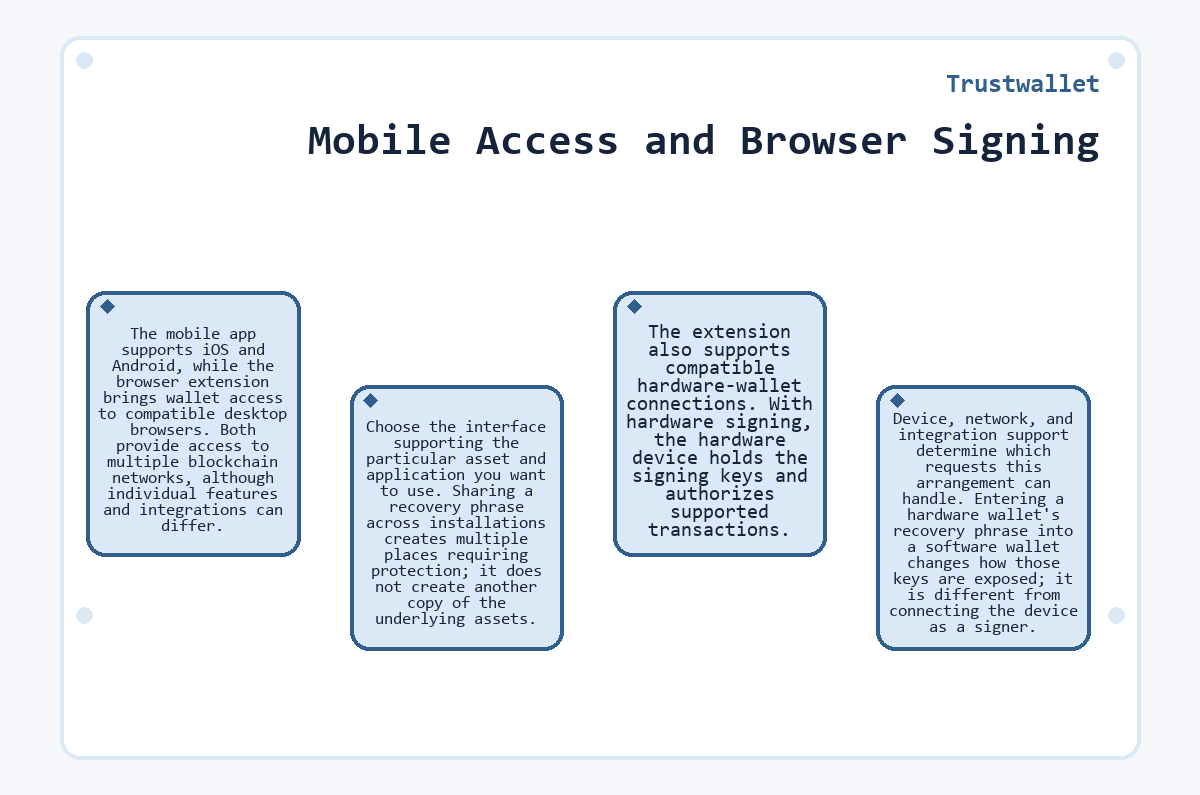
The extension also supports compatible hardware-wallet connections. With hardware signing, the hardware device holds the signing keys and authorizes supported transactions. Device, network, and integration support determine which requests this arrangement can handle. Entering a hardware wallet's recovery phrase into a software wallet changes how those keys are exposed; it is different from connecting the device as a signer.
Network Balances and NFT Collections
The wallet manages supported assets across networks, including Bitcoin and Ethereum, with each network retaining its own transaction rules. A coin or token belongs to a specific blockchain context. A matching name or ticker does not establish that tokens on different networks are interchangeable. For contract-based tokens, the network and contract address identify the asset more precisely than its display label.
Receiving crypto uses the address for the selected asset and network. Sending from an exchange also depends on that exchange's withdrawal network and any destination requirements. When a recipient requires a memo or destination tag, that information forms part of the receiving instructions. A matching address format can still conceal a network mismatch, so compatibility must include the network selection.
NFT support adds collectible-token display and management. Collection identity and token identifiers distinguish individual assets; artwork alone does not establish authenticity.
Swaps and Connected Trading Services
Swaps exchange assets through integrated providers, while connected applications and trading integrations operate under their own contract and service rules.
Swaps Within and Across Networks
A same-network swap changes the asset held on one blockchain through the selected trading route. A cross-network swap also involves delivery on another blockchain. These operations have different settlement dependencies, even when the wallet presents a unified interface. The available route determines supported assets, charges, and expected delivery. A source-network transaction can finish before a cross-network service completes delivery, so its confirmation alone cannot prove the entire swap succeeded.
Quotes and Token Permissions
A quote describes the proposed exchange terms, including the expected output and applicable charges. Liquidity and price movement can change execution; a displayed estimate is not a promise of the final amount. Where the route enforces a minimum received amount or slippage limit, a swap that would breach that bound fails. Some token swaps require a spending permission for a contract. That permission has its own scope, which matters beyond the immediate trade.
Connected Applications and Derivatives
Decentralized applications, often called dApps, request wallet connections and signatures for their services. WalletConnect connects the mobile wallet to compatible dApps, including those accessed through desktop browsers. A connection and a spending authorization are distinct permissions. Perpetual-futures integrations include Hyperliquid and Aster DEX, with access varying by region and venue. Their leveraged positions introduce margin requirements and liquidation risk, without conferring ownership of the underlying asset. Holding your signing keys does not remove the rules governing posted collateral.
Fiat Purchases and Cash-Out Services
Buying and selling crypto through the wallet uses third-party providers whose eligibility rules determine the available payment and payout methods. Availability varies with location, asset, provider, and payment method. A provider may require identity verification and impose its own processing limits. A purchase order and the resulting blockchain deposit are different records; a payment authorization alone does not prove delivery of crypto. Compare the amount delivered after disclosed charges, and direct order-processing problems to the provider handling that purchase or sale.
Network Fees and Alternative Fee Payments
Transaction costs follow the chosen network and operation, with provider charges adding a separate cost layer where applicable. Ordinary network fee payment generally uses the chain's native asset, which can require a balance separate from the token being sent. Execution complexity and network demand influence fees. A fee estimate can change before submission, and receiving a token does not automatically supply the fee funding needed to send it later.
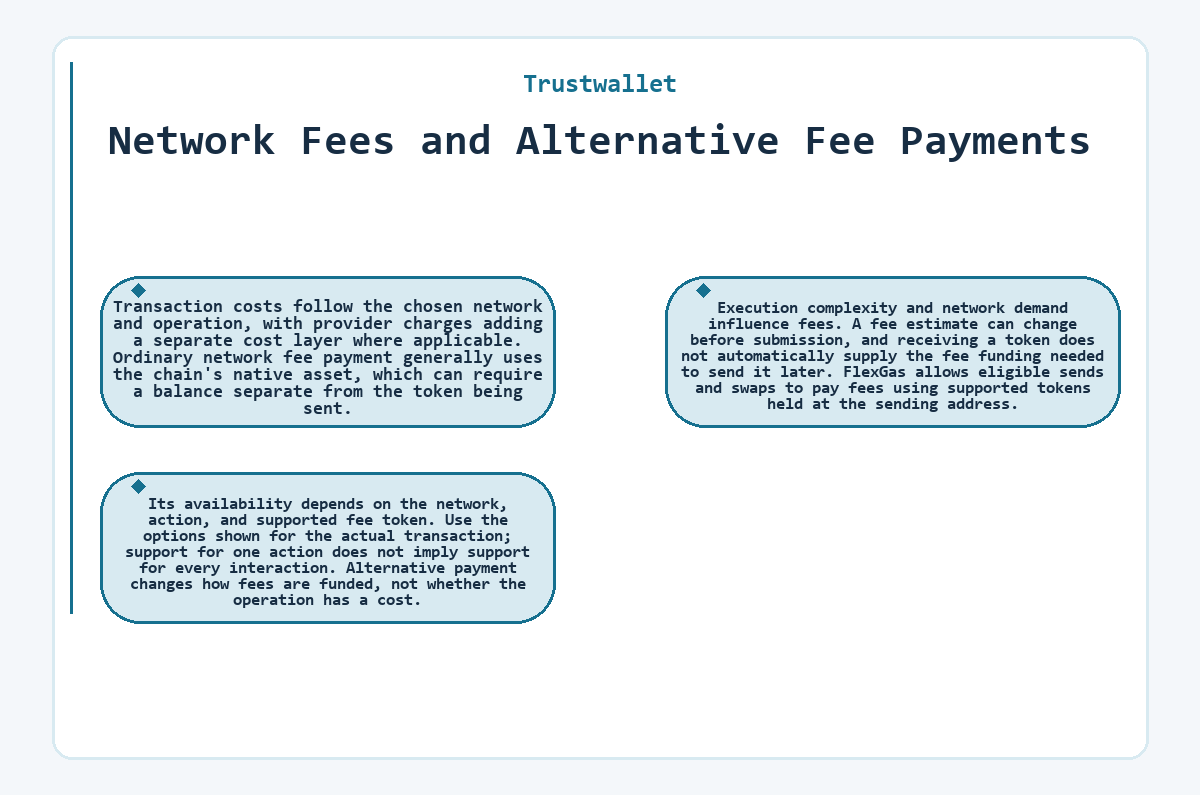
FlexGas allows eligible sends and swaps to pay fees using supported tokens held at the sending address. Its availability depends on the network, action, and supported fee token. Use the options shown for the actual transaction; support for one action does not imply support for every interaction. Alternative payment changes how fees are funded, not whether the operation has a cost.
When Can Staked Crypto Be Withdrawn?
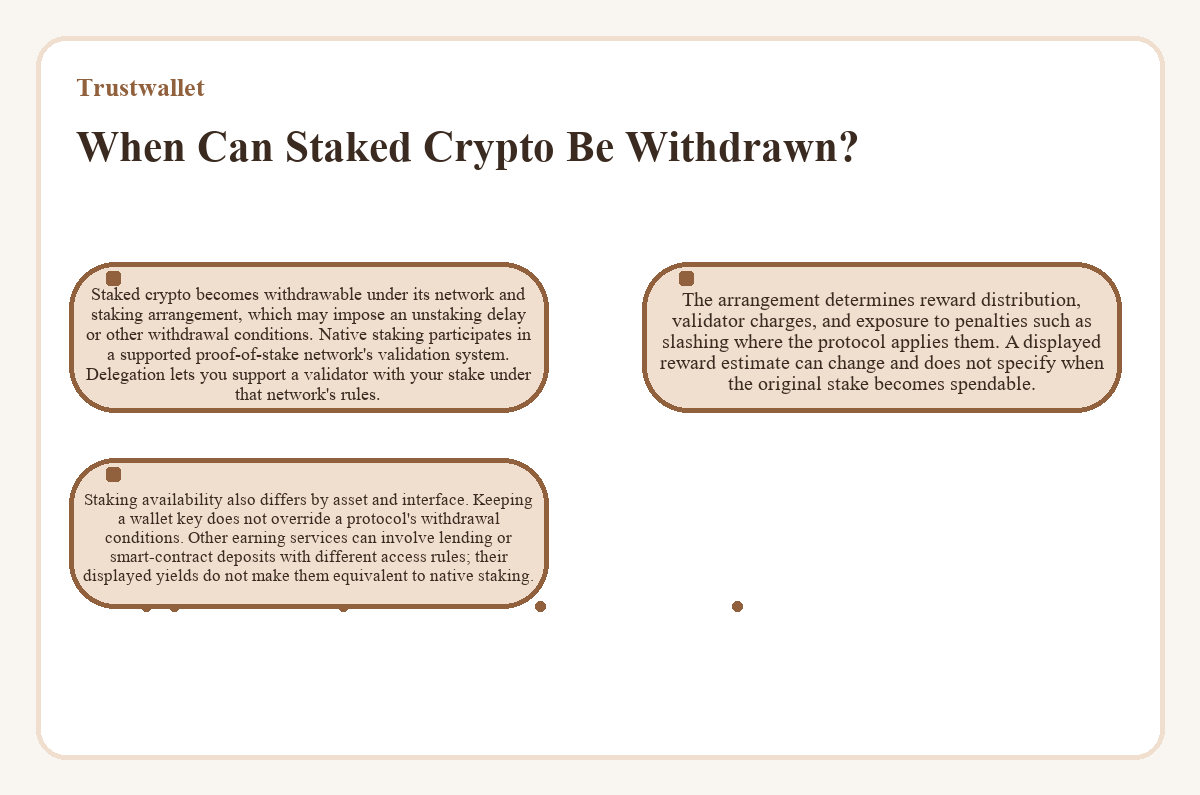
Staked crypto becomes withdrawable under its network and staking arrangement, which may impose an unstaking delay or other withdrawal conditions. Native staking participates in a supported proof-of-stake network's validation system. Delegation lets you support a validator with your stake under that network's rules. The arrangement determines reward distribution, validator charges, and exposure to penalties such as slashing where the protocol applies them. A displayed reward estimate can change and does not specify when the original stake becomes spendable.
Staking availability also differs by asset and interface. Keeping a wallet key does not override a protocol's withdrawal conditions. Other earning services can involve lending or smart-contract deposits with different access rules; their displayed yields do not make them equivalent to native staking.
Key Protection, Contract Permissions, and Privacy
Wallet protection requires securing signing access, understanding contract permissions, and recognizing the information a public blockchain exposes.
Device Locks and Recovery Material
App locks and supported biometric controls restrict access through the device. A phrase-based wallet also needs a protected recovery phrase, which can recreate signing access independently of that app lock. Keep the phrase away from messages, unsolicited support requests, and web forms claiming to validate the wallet. Trustwallet cannot reconstruct a lost phrase for you. Encrypted backup features, where supported, have their own access requirements; ordinary screenshots or unencrypted online copies expose the secret to additional systems.
Spending Allowances and Risk Warnings
A token approval can allow a smart contract to spend the approved tokens within the granted allowance. Disconnecting an application session does not itself revoke an on-chain allowance. Approval-management features provide a way to inspect and revoke supported permissions; revocation can require a network transaction and fee. The Security Scanner checks supported transactions for risk signals before signing. Its coverage and threat information have limits, so an absence of warnings cannot establish that an unfamiliar contract is safe.
Public blockchain records expose address activity, and payment providers apply their own data practices. When a service connects an address with your identity, its public transaction history can become attributable to you.
Still wondering about Trustwallet?
Will Uninstalling Trustwallet Delete My Cryptocurrency?
Uninstalling the app does not remove assets recorded on a blockchain, but it can remove the local access needed to manage them. For a phrase-based wallet, restoring access requires its valid recovery material and compatible wallet software. Before deleting an installation, make sure its backup is accessible and belongs to the wallet holding the assets; an app password alone cannot restore signing keys.
How Can a Confirmed Deposit Be Missing From the Asset List?
A confirmed deposit can be absent from the visible asset list because the token is hidden, missing from the default list, or associated with another selected wallet or network. Check the receiving address and token identity in the network's transaction record. Adding a supported custom token changes its display in the wallet; it does not create funds or move an asset between networks.
Is the Displayed Fiat Balance Available as a Cash Withdrawal?
The fiat balance is a valuation estimate of the displayed crypto, not a cash balance held for withdrawal. Converting an asset into a payout requires a supported selling service and its payment arrangements. The eventual payout can differ from the estimate because executable rates, liquidity, and fees differ from displayed market valuations. A token's visible price does not establish that a provider will buy it.
What Details Help Diagnose a Trustwallet Error?
A useful error report identifies the affected network, app version, and exact error message. For a transaction problem, the public transaction identifier helps locate its blockchain record. Specify whether the problem concerns asset display, signing, or a provider's order, since those involve different systems. Exclude recovery phrases, private keys, and backup files; diagnostic information should describe the problem without giving anyone signing access.
Does Adding a Separate Wallet Combine Its Balances With My First Wallet?
Adding a separate wallet does not combine its assets at one blockchain address. Multi-wallet management keeps several wallets accessible within the app or extension, while their funds remain associated with their respective addresses. Each independently created wallet needs its own backup. Backing up your first wallet does not preserve signing access to another wallet created with different keys.