Trustwallet recovery phrase regenerates the keys behind your wallet addresses
Trustwallet recovery phrase restores a phrase-backed wallet by regenerating its private keys from the original ordered words and any required BIP39 passphrase. A compatible wallet uses those keys to access the same blockchain addresses. Restoring access does not move the assets, and an app passcode cannot substitute for the phrase.
Recovery Words and Other Access Materials
A recovery phrase can rebuild the keys for a phrase-backed wallet, while a private key restores narrower signing access and a public address permits monitoring without signing. An encrypted phrase backup supplies the same underlying secret after decryption. A local app lock protects an existing installation.
| Access Material | What It Provides | Required Context | Recovery Limitation |
|---|---|---|---|
| Original recovery words | Keys for accounts derived from the phrase | Compatible derivation and any original BIP39 passphrase | Incorrect words or settings can prevent the expected recovery |
| Encrypted phrase backup | The saved phrase after decryption | Accessible backup and its encryption password | A missing backup or password blocks this recovery route |
| Individual private key | Signing access to accounts controlled by that key | Supported network and private-key import format | Does not reconstruct the wallet's complete key tree |
| Public address | Read-only account monitoring | Correct network and address | Cannot sign transactions or reveal the recovery phrase |
| App passcode or biometrics | Access to locally stored wallet data | Existing installation and successful authentication | Cannot regenerate missing wallet keys |
A public address can reveal an account's transaction history and balances, so sharing it also has privacy consequences.
From Random Words to a Tree of Keys
The recovery words encode random information, which the wallet converts into a seed before deriving account keys and addresses through deterministic cryptographic operations with matching inputs.
Randomness and the Checksum
Trustwallet's standard phrase-backed wallet creates a 12-word phrase. BIP39 maps random bits and a checksum into words from a defined wordlist. The checksum helps detect transcription errors, but it neither corrects the words nor proves they belong to the intended wallet. Choosing a memorable sentence yourself replaces the wallet's random generation with a predictable input.
The Seed and Derived Keys
BIP39 derives a 64-byte seed from the mnemonic and its passphrase input. A hierarchical deterministic wallet derives a tree of keys from that seed. Each derivation path selects a branch; the selected key produces its public key and corresponding address. This relationship lets a backup recreate many accounts without storing every private key separately.
The words do not contain a balance. Blockchain records determine the assets associated with each derived address.
Local Passwords and BIP39 Passphrases
A local wallet password and an additional BIP39 passphrase protect different objects: the password restricts app access, while the passphrase participates in deriving the wallet's seed.
App Locks and Backup Encryption
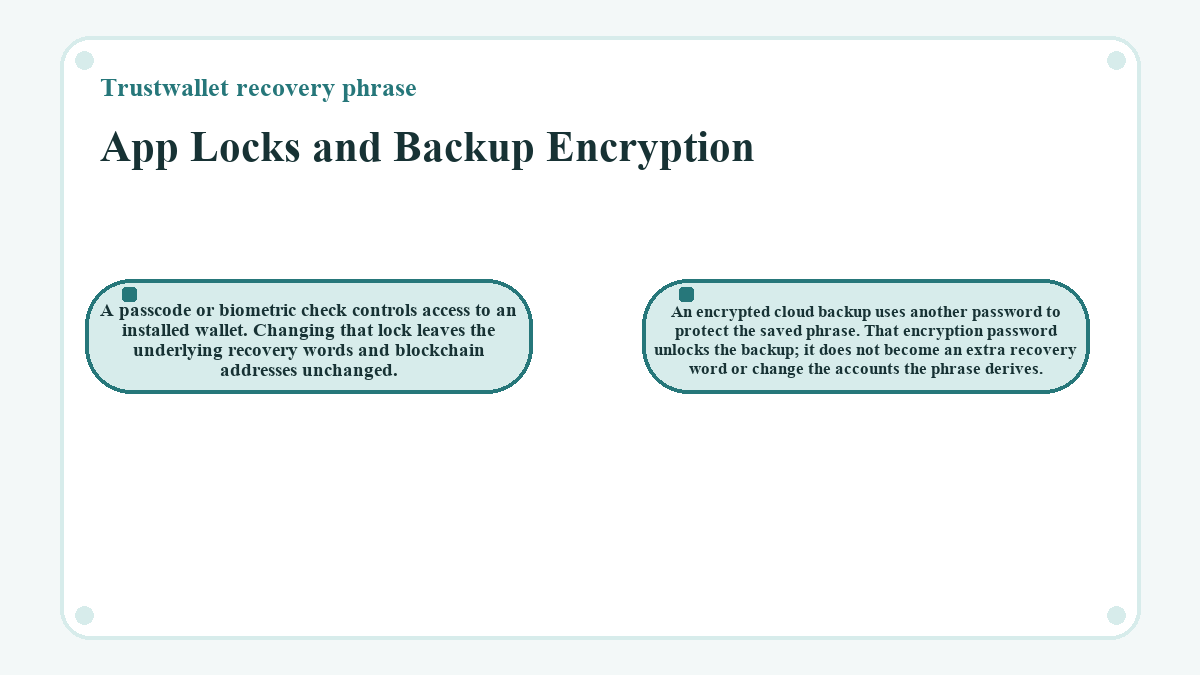
A passcode or biometric check controls access to an installed wallet. Changing that lock leaves the underlying recovery words and blockchain addresses unchanged. An encrypted cloud backup uses another password to protect the saved phrase. That encryption password unlocks the backup; it does not become an extra recovery word or change the accounts the phrase derives.
An Additional BIP39 Passphrase
A wallet originally created with an additional BIP39 passphrase requires that exact input during restoration. Every passphrase produces a seed, so a mistyped passphrase can produce valid, unfamiliar addresses without an error. An import interface must support this option to recover such a wallet. Wallet Core's protocol capability does not establish support in every Trustwallet interface.
Why Can the Same Recovery Phrase Show Different Addresses?
The same recovery words can produce different addresses when the importing wallet uses a different passphrase, derivation path, account index, or supported address format for the selected network.
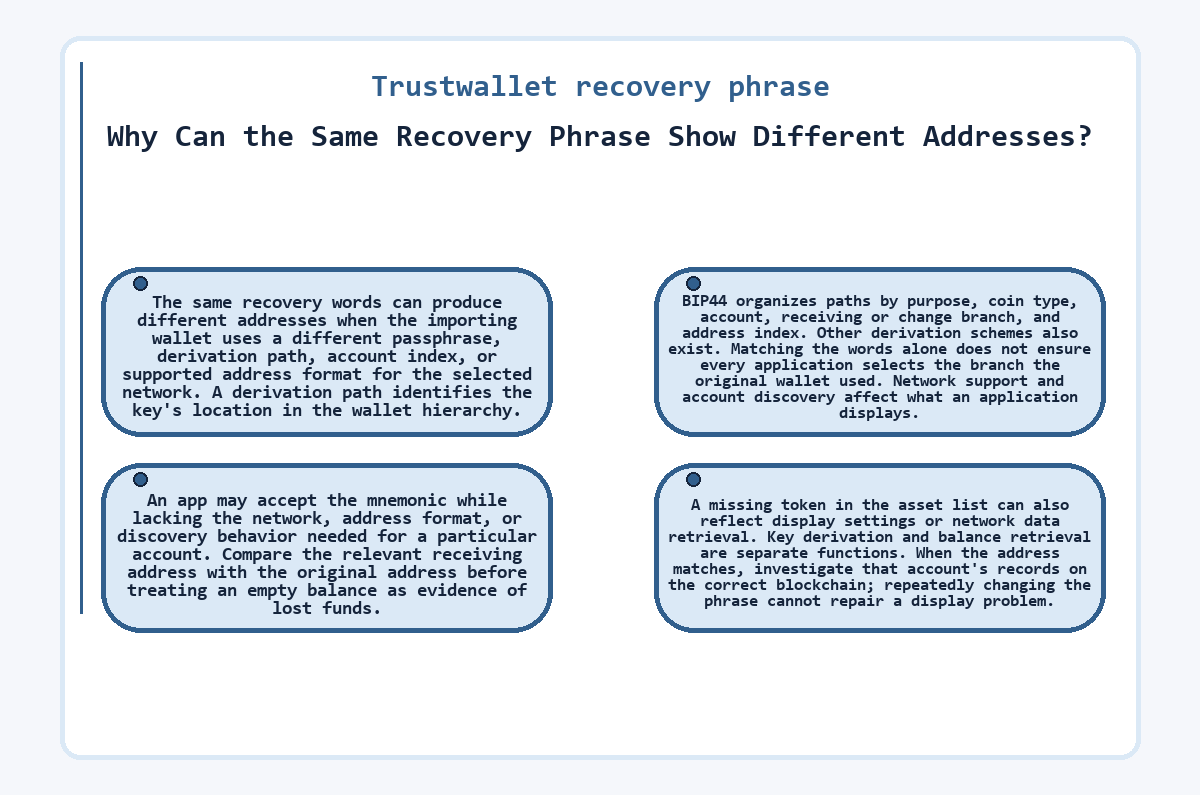
A derivation path identifies the key's location in the wallet hierarchy. BIP44 organizes paths by purpose, coin type, account, receiving or change branch, and address index. Other derivation schemes also exist. Matching the words alone does not ensure every application selects the branch the original wallet used. Network support and account discovery affect what an application displays. An app may accept the mnemonic while lacking the network, address format, or discovery behavior needed for a particular account. Compare the relevant receiving address with the original address before treating an empty balance as evidence of lost funds.
A missing token in the asset list can also reflect display settings or network data retrieval. Key derivation and balance retrieval are separate functions. When the address matches, investigate that account's records on the correct blockchain; repeatedly changing the phrase cannot repair a display problem.
Restored Access and Unchanged Blockchain Records
Restoration reconstructs signing access on a device, leaving the wallet's existing blockchain transactions and balances intact because importing the phrase does not submit a transfer to the network.
The phrase recovers accounts derived from it. A private key imported separately has its own backup requirements and does not automatically join the phrase's key tree. Similarly, separate wallets with independently generated phrases require their own recovery material. Treating all entries in one app as a single backup scope can leave an account unrecoverable.
An accessible phrase-backed installation may still reveal its original words through the selected wallet's manual backup controls after authentication. Preserve that access until the backup is complete. Clearing app data or deleting the wallet before saving usable recovery material can remove the remaining local keys.
Trustwallet cannot retrieve a lost recovery phrase from a central recovery database. A saved encrypted backup or separately preserved private key may still provide relevant access. If no usable signing keys or recovery material remain, a public address can show the funds but cannot authorize spending.
Physical Copies and Encrypted Backups
A physical backup preserves the words outside the device, while an encrypted digital backup preserves a protected copy whose recovery depends on access to its storage and encryption password.
Readable Offline Copies
Record every word in its original order and make the sequence unambiguous. Paper avoids online account exposure but can suffer physical damage. Durable metal storage can improve resistance to damage, although its protection depends on the material and storage conditions. Separate secure locations reduce the chance one incident destroys every copy; additional copies also create additional places requiring protection.
Encrypted Digital Storage
Where Trustwallet's Encrypted Cloud Backup option is available, it stores an encrypted copy of the phrase. Its password should differ from the cloud account password. Plain screenshots, email drafts, and unencrypted notes lack that separation and can expose the words through device access or synchronization. Losing a backup's password blocks that copy's decryption, even if another readable backup remains usable.
Exposure and the Limits of Reusing a Phrase
Exposed words allow key reconstruction with any required BIP39 passphrase; changing an app password or deleting a leaked image cannot revoke that access.
Enter recovery words only into the intended recovery interface of a genuine wallet application on a device you trust. A support conversation, token swap, or connected dApp has no legitimate need for the phrase. Sharing it to fix a connection gives the recipient access far beyond that session. A replacement wallet with a freshly generated phrase has different keys. Moving remaining assets to its compatible addresses requires actual blockchain transactions and applicable network fees. Importing the exposed phrase again retains the original vulnerability. An attacker may already control the affected accounts, and restoring their keys cannot reverse completed transfers.
Questions people ask about Trustwallet recovery phrase
Does Importing a Recovery Phrase Incur a Blockchain Fee?
Importing a recovery phrase does not incur a blockchain transaction fee because it only reconstructs local keys. Network fees apply to subsequent on-chain transactions, such as moving assets to an address derived from a new phrase. A payment request to activate recovery words is unrelated to key derivation.
Can the Same Recovery Phrase Remain Active on Two Devices?
The same recovery words and any required BIP39 passphrase can generate signing access on multiple compatible devices. Both devices control the same derived accounts, so they do not create separate holdings. Removing one installation does not revoke the other's keys, and a compromise of either device can expose the shared accounts.
What Happens If I Replace a Missing Recovery Word With a Word I Choose?
An arbitrary replacement does not reliably recover the original wallet. It may fail the checksum or produce a different valid phrase. Even a phrase an application accepts must derive the original addresses to identify the intended wallet. Keep the incomplete backup private; online phrase-checking services can collect its remaining words.
Will My Recovery Words Expire If I Leave the Wallet Unused?
A BIP39 recovery phrase has no built-in expiry date. The same words and passphrase input continue deriving the same seed. Access also requires compatible software and the relevant blockchain's operation. Inactivity does not make the words safe to disclose or erase anyone else's copy of them.
Should I Translate My Recovery Words Into Another Language?
Keep the recovery words in their original language and spelling. BIP39 derives the seed from the actual mnemonic text. Translating words into different spellings changes that input, even if their meanings stay similar. A translated phrase cannot substitute for an accurate transcription of the original backup.
How Much Recovery Information Is Safe to Share With Support?
Share the error message and relevant app version without including recovery words, private keys, or backup passwords. A public address can help identify the affected account, but it may reveal balances and transaction history. Check screenshots for secrets before sharing them; support does not need signing authority to discuss an error.
Is a Recovery Phrase Available for a Trustwallet SWIFT Wallet?
Trustwallet SWIFT uses passkeys instead of a recovery phrase to create, secure, and recover its smart contract wallet. A phrase from a separate wallet cannot substitute for the SWIFT wallet's passkey.
Are Wallet Names and Custom Token Settings Included in the Recovery Phrase?
The recovery phrase encodes the information used to derive keys, not your app's wallet names or custom token settings. A compatible restoration can recover account access even when you must add local preferences again. Missing local labels do not change the underlying keys or the blockchain records for their addresses.